Monday, April 7, 2014

"To live is to suffer, to survive is to find some meaning in the suffering."

Existentialism is a very intricate and complicated subject to address. Philosophy in general is. The very subject broaches the entirety of human thought and emotion beyond language, and so attempting to define it and understand it in the terminology of written words is nigh on impossible. Definitions stretch on for pages on pages; they transcend "Definitions" and become essays on the subject. Simplicity is destroyed, as even the most basic terms must be defined in terms of every other philosophical term out there, without being defined by characteristics of itself or defining itself with characteristics of others that also happen to be have the same characteristics. It gets pretty 'deep'. That being said, let's try to understand, simply, the philosophy of existentialism. As far as I can tell, existentialism falls into the philosophical category of human purpose, drawing purpose of life from the individual, with their own free will and soul. There is some supernatural or otherworldly aspect, not necessarily religious, but not definable in terms of matter, science, and causality alone. Philosophy is also difficult to deal with because, with its very complex nature, it becomes incredibly specific, and differing viewpoints on only a couple facets send a whole new philosophy spinning off into being.
For example, I share with existentialism the belief that purpose is begotten from the individual: you make your own purpose in life by your actions: not necessarily that every person has a specific self-created purpose to follow, but that if you wish to find purpose, look to yourself and mind, which means that people can very easily exist without a purpose, and very many in fact do not have purposes. I do not, however, subscribe to the illusion of free will, meaning that while there are no set purposes to follow, every person's purpose, as defined by their actions, being predeterminate, is already set. I also do not subscribe to the philosophically idealist views of existentialism [philosophical idealism and materialism are two opposites in philosophy: idealism is the belief in things that transcend the real world, things such as planes of existence beyond our own like heaven or hell, or that consciousness arose beyond matter and only inhabits matter by choice. Materialism states that there is only the real world, with only matter and scientifically explainable phenomena, and that consciousness has arisen from the highest possible state of matter.], so one might call me a materialist existentialist. But this still does mot encompass all the philosophical views I possess. In addition, I am a dialectic [the Hegelian philosophy of change or motion, especially in a social sense when applied to Marxism, that encompasses the drastic and sudden change from quantitative to qualitative fluctuation and vice versa, the unity of opposites, the negation of the negation, and so on], a Marxist [or scientific socialist, which really encompasses dialectical materialism, historical materialism, and Marxist economics], an atheist [which also sometimes, but not always, includes materialism], a hard determinist [which actually happens to be very difficult, but not impossible, to rectify with existentialism of any sort], a realist [not just materialism, but that everything we observe as the real world is actually real], a moral relativist [which just so happens to be morally iffy, which by its very nature I care little about], and so on.
However, of all the philosophical fields out there, the philosophies for finding meaning to life are by far the most complex, as they try to find an answer to the great question "Why are we here?", a question that has plagued conscious thought since its beginning. This is also the most difficult answer to accept [if an answer to the question is ever found]. Almost every belief system out there stems from some facet of this question, not only belief systems to answer questions about the world around, but also as to why we are the ones that can actually acknowledge it. Most belief systems were created to form false senses of grandeur and purpose in this universe, [before I go on I should specify that my views for the purpose of human life are that purpose is not actually tangible or given, it is a relative, subjective, and self-prescribed comfort] as people fail to accept either the truth that they have no given purpose or they fail to accept the responsibility of being given their own purpose to procure. Deep stuff.

Thursday, April 3, 2014

"The bourgeoisie has torn away from the family its sentimental veil, and has reduced the family relation to a mere money relation."

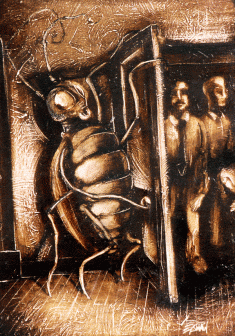
So funny story Gregor Samsa's family is a giant hulking piece of shit. Even before where the story begins, his family has thrust onto their son their massive debt, forcing him to work in a job he hates to pay it off. In the beginning, Gregor wakes up, and realizes he is late to work, and thinks to himself of the necessity of getting to work, " 'right now I have to get up. My train leaves at five o’clock' ” (Kafka 1). He, even in the state of being a bug, is still absolutely determined to get to work, work that he hates, in order to pay off a debt that isn't even his. AS muses about quitting, " 'If I didn’t hold back for my parents’ sake, I’d have quit ages ago. I would’ve gone to the boss and told him just what I think from the bottom of my heart' " (Kafka 1). Gregor wants desperately to leave, to quit, but he feels such loyalty and adherence to his parents' wishes that he feels he must help them. His parents' brainwashing of him has gotten to the point that Gregor even feels the debt is his own: not just the responsibility to pay it is his, but the very debt itself is his. As he talks to his manager after he lets him into his room, he says, " 'I am really so indebted to Mr. Chief—you know that perfectly well' " (Kafka 7). He has willingly taken on the debt as his own, devoted as he is to his parents, and they let him suffer for their own good. His family is taking advantage of him, working him miserably to the bone. They tell him they love him and they care for him to his face while their hands whip him in the back and force him to the ground to work
Gregor is indebted, at the rate he's going at now, to be working for five or six more years, "that [paying off the debt] should take another five or six years" (Kafka 1). He's resigned to working in misery for six years to pay off this debt, but he doesn't actually have t work for that long! Later, it is revelead that not only is his family living off the work that he does, taking the money to fund their own bloated lifestyles, they aren't even using all the possible money to pay off their debt, "the money which Gregor had brought home every month—he had kept only a few crowns for himself—had not been completely spent and had grown into a small capital amount" (Kafka 12). They are taking and hoarding and taking money from Gregor, the only person in the family that's actually doing anything productive or supportive, leaving him poor and overworked, resigned to continue being taken advantage of for years to come. At least in the end they finally get their due (partially) while they themselves get put to hard work, "they had been struck by a misfortune like no one else in their entire circle of relatives and acquaintances. What the world demands of poor people they now carried out to an extreme degree. The father bought breakfast to the petty officials at the bank, the mother sacrificed herself for the undergarments of strangers, the sister behind her desk was at the beck and call of customers, but the family’s energies did not extend any further" (Kafka 19). They now feel the soreness of hard labor, know what it is to support not only yourself but also something which does nothing on its own and must be taken care of. They deserve every iota of suffering they receive at the hands of their new situation, and it is a cruel disjustice that it is Gregor that dies in the end to leave his family to their own prosperous future, and not the family that lies down and dies like the dogs they are. Instead the bourgeois swine crawl away to reap the rewards of a new dominion.

Friday, March 21, 2014

"Gregor Samsa was right. We are all bugs."

How Kafka presents Gregor's family and boss in Metamorphosis is incredible, in terms of how fucking awful they are, especially when in contrast to Gregor's loyalty to his parents and drive and desire to do this thing for them. His manager, when yelling to Gregor behind the door, " 'I thought I knew you as a calm, reasonable person, and now you appear suddenly to want to start parading around in weird moods... I see here your unimaginable pig headedness, and I am totally losing any desire to speak up for you in the slightest. And your position is not at all the most secure. Originally I intended to mention all this to you privately, but since you are letting me waste my time here uselessly, I don’t know why the matter shouldn’t come to the attention of your parents as well. Your productivity has also been very unsatisfactory recently' " (Kafka 5). We see the boss shrieking at Gregor, being mean, and terrible, and condescending. Gregor responds to his manager with, " 'There is really no basis for the criticisms which you’re now making against me. Nobody has said a word to me about that. Perhaps you have not read the latest orders which I sent in. Besides, now I’m setting out on my trip on the eight o’clock train... I will be at the office in person right away. Please have the goodness to say that and to convey my respects to the Chief' ” (Kafka 5) He is cordial, and polite, and keeps his head cool, and defends himself quietly and civilly. His boss yells and screams and insults, and Gregor responds with kindness and gentle retaliation.

Gregor's parents, also, are terrible people. They're lazy, and will not pay off their own debt. They even have servants of their own, whom they pay instead of paying off their debt. Gregor is forced to work indentured for many years to pay off the debt. As he sits, mulling, in his bed, "If I didn’t hold back for my parents’ sake, I’d have quit ages ago. I would’ve gone to the boss and told him just what I think from the bottom of my heart. Once I’ve got together the money to pay off my parents’ debt to him—that should take another five or six years—I’ll do it for sure" (Kafka 1). He will have to work years of his life at a job he absolutely despises, underneath a boss whom he hates with a passion. But even through this, even though his parent's debt is his parents' fault, he even seems to consider the debt his own, his responsibility. As he talks to his boss, after they get into his room, " 'I am really so indebted to Mr. Chief—you know that perfectly well. On the other hand, I am concerned about my parents and my sister' " (Kafka 7). He considers the debt to be his own, and he's even worried about his family, despite the fact that he has been turned into a bug and is being forced to work against his will by his parents. The debt is not his own, and yet he sees his own responsibility to pay it off.